
Uncategorized
Josh Madakor's Cyber Range Review: Does the Internship Actually Get You Hired?
Table of Contents
- What Exactly Is The Cyber Range?
- The Employability Framework
- The Tier List: What Actually Gets You an Interview
- The Internship
- Real Wins From Inside The Range
- What You Actually Get When You Join
- The Honest Cons
- Is a Job Guaranteed?
- Frequently Asked Questions
- Is the internship paid?
- How fast are people actually getting hired?
- Do I need a degree or IT experience before joining?
- Is a job guaranteed if I join?
- How is this different from free tutorials on your YouTube channel?
- Do I need a powerful computer or VM software to do the labs?
- How is this different from the older course sold under the Leveld brand?
- What kinds of tasks can I actually do for internship credit?
- How much can I realistically expect to make starting out?
Hey, it’s Josh Madakor.
Today I’m answering the questions I actually get asked the most: What is The Cyber Range? How does the internship work? What can you actually do inside it? And does any of this actually get you hired? Real member wins included — no cherry-picked marketing testimonials, just recent posts from inside the community.
About Josh Madakor I started in IT in 2007 as a help desk technician. Since then I’ve worked across government, finance, and defense contracting, and spent time as a contractor with Microsoft, where I helped develop the Microsoft Cloud Security Benchmark. I earned my Master’s from Western Governors University, and I’ve been teaching IT and cybersecurity on YouTube to 200K+ subscribers. The Cyber Range is the hands-on training community I built out of everything I wish someone had handed me when I was starting out.
What Exactly Is The Cyber Range?
The Cyber Range is my paid community on Skool. It’s not a course where you watch videos and take a quiz. It’s a live, shared production environment — basically a home SOC (Security Operations Center) that everyone in the community uses together, built with actual enterprise tools instead of watered-down simulations.
Right now that means:
- Microsoft Sentinel (cloud SIEM) for security operations and threat hunting
- Tenable (fully licensed) for vulnerability management
- Microsoft Defender for Endpoint
- Azure, since the whole environment runs in the cloud
You’re not clicking through a fake sandbox someone built for a tutorial. This is our actual company tenant — the one we pay for. Cloud consumption alone runs about $6,000/month, not counting engineering cost, across an environment with several hundred virtual machines and close to 1,000 users. The logs are organic. The attack traffic is organic. It’s the same experience as getting hired at a real company and being handed credentials to Azure, a SIEM, an EDR platform, and a vulnerability management tool — except you get better training than most people get at an actual job.
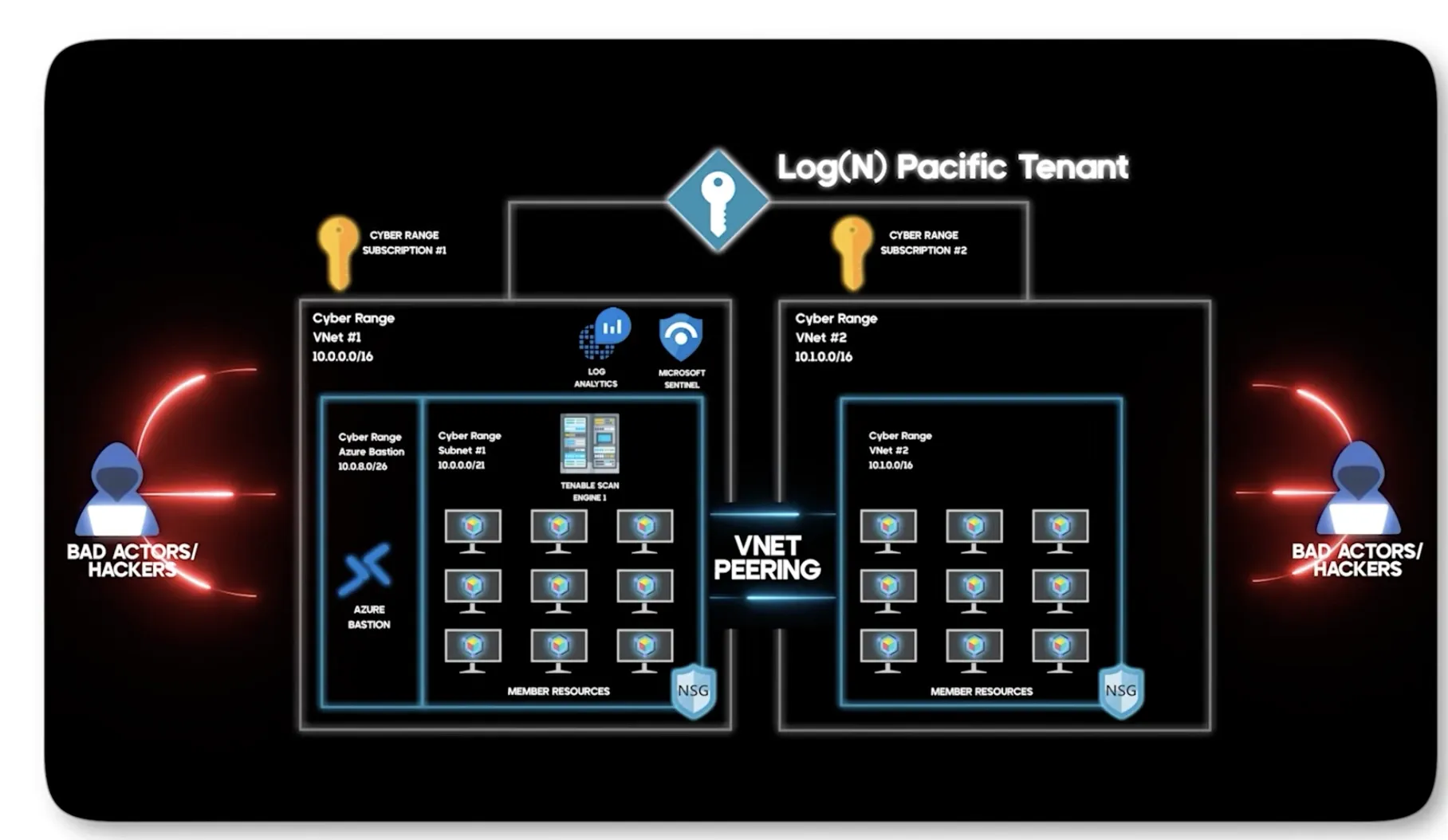
If you’ve ever done one of my free YouTube labs — like the home SOC project where we build a honeypot and map live attacks — that lab is a massively watered-down version of what’s actually inside The Cyber Range. Same idea, way more depth.
The Employability Framework
Before I get into pricing, I want to explain the actual thinking behind The Cyber Range, because it’s not just “here’s some tools, good luck.”
I spent years going from broke to comfortably making $100K–$200K in corporate IT and cybersecurity, and along the way I noticed something: almost everything that matters when you’re trying to break in boils down to two things.
- Can you get the interview?
- Can you pass it?
That’s it. If what you’re spending your time on doesn’t move the needle on one of those two things, you’re probably wasting your time. That framework is the entire foundation of how The Cyber Range is structured.
The Tier List: What Actually Gets You an Interview
To go with the framework, I built a tier list of the things hiring managers, recruiters, and applicant tracking systems actually respond to — from most convincing to least convincing.
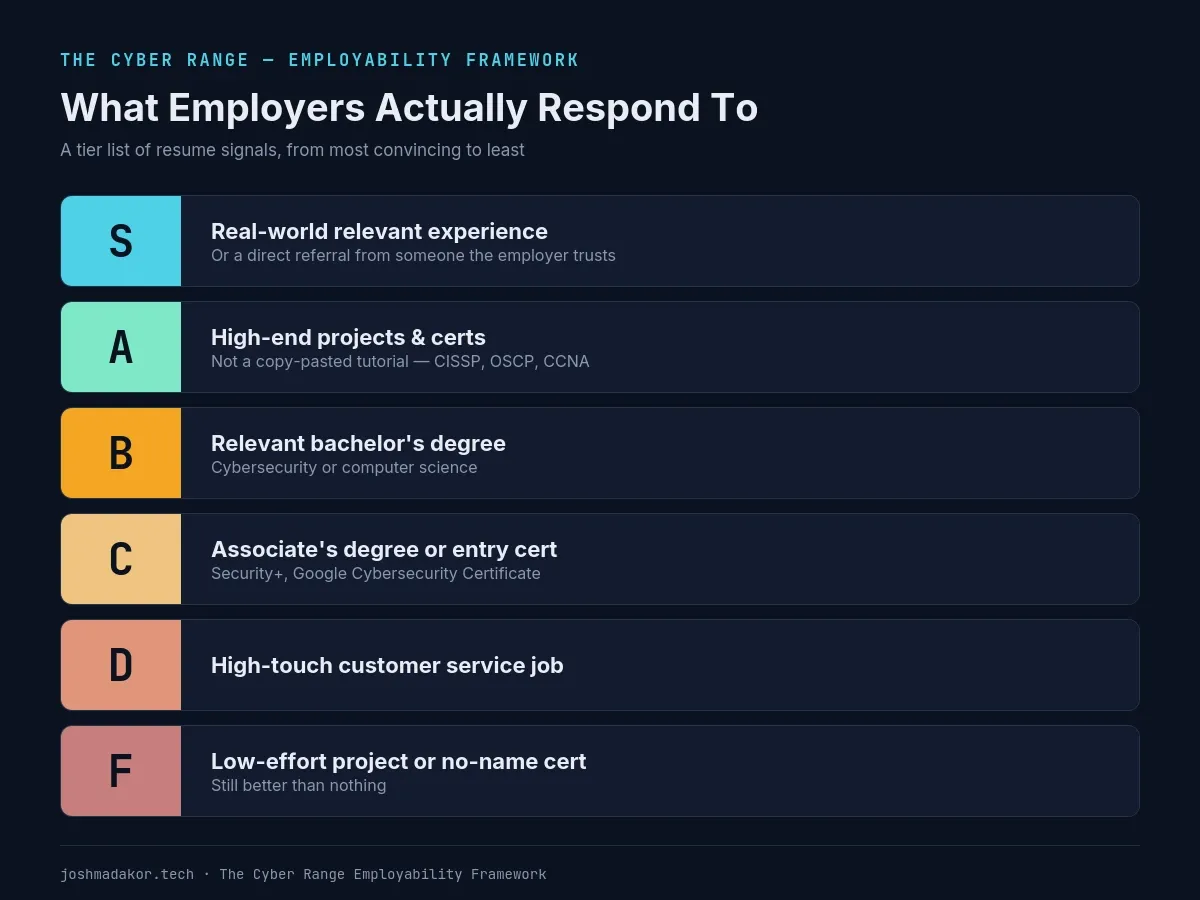
A quick clarification, because I don’t want this misread: F-tier doesn’t mean worthless. It just means it’s the least convincing thing on your resume compared to S-tier stuff. Something is always better than nothing.
The important part is this: when the job market is tight, employers pull almost exclusively from S-tier and A-tier. If everyone applying already has a bachelor’s degree and Security+, that combo isn’t distinguishing you from anyone. You need something that most other applicants don’t have.
That’s specifically why The Cyber Range exists — it’s designed to help you build S-tier and A-tier stuff, which are also the hardest things to get on your own. (I originally laid all of this out in more detail in this video, if you want to see it explained start to finish.)
The Internship
This is probably the single biggest value driver in The Cyber Range, and it was recently overhauled, so I want to walk through exactly how it works.
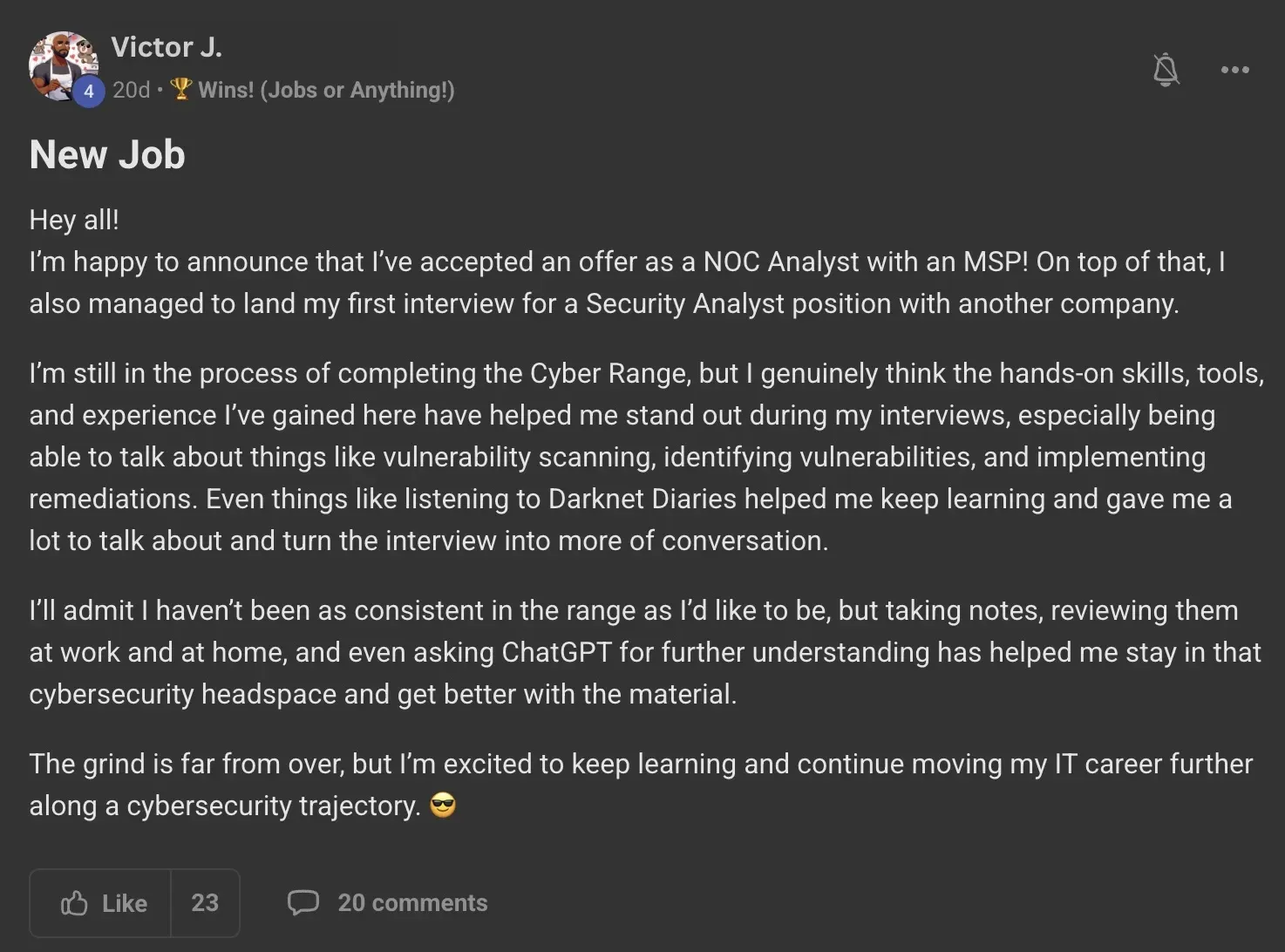
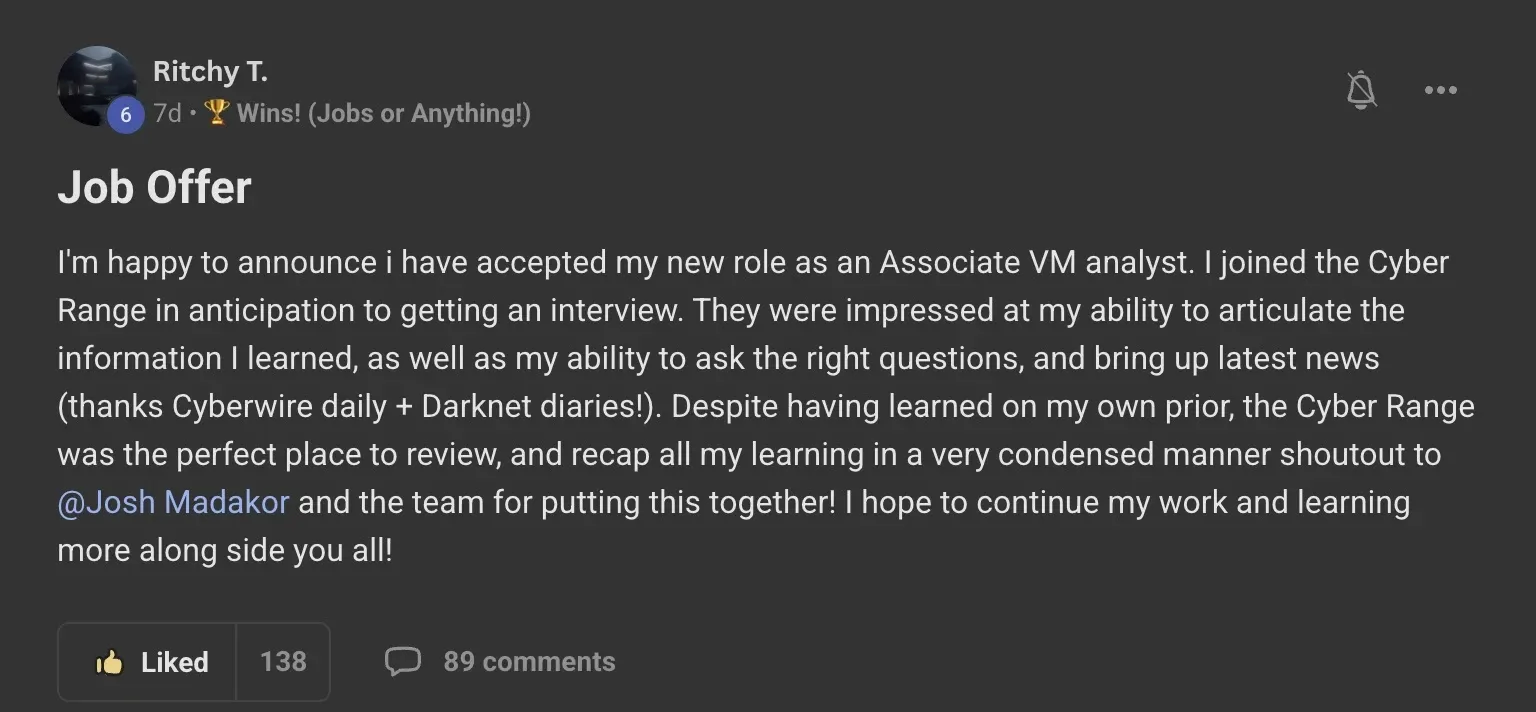
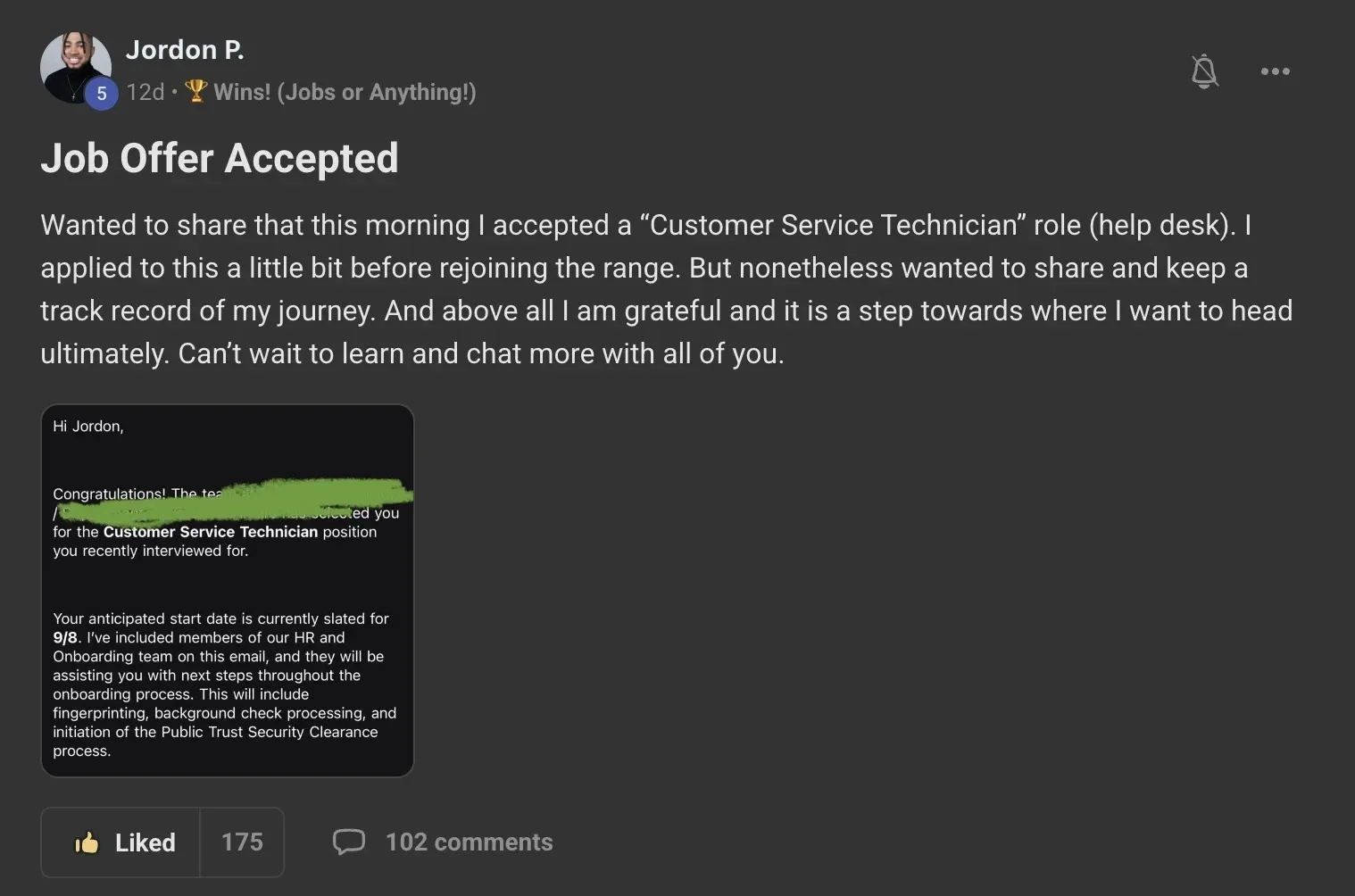
The company behind all of this is LogN Pacific, and in 2026, someone from the community lands a job roughly every 3 days on average. About half of those hires were general IT roles rather than cybersecurity-specific — SOC analyst, sysadmin, help desk, NOC, systems engineer, GRC — so don’t assume this only pays off if you land a pure security title.
Here’s the actual pipeline, start to finish:
- Complete the core courses — Vulnerability Management and Cyber Defense, which cover the theory and hands-on mechanics of security operations
- Pass the Cyber Range exam — a 50–60 question multiple-choice test
- Complete a vulnerability management task, or rack up 20 community technical assists (answering other members’ questions in the community counts as one assist each) — you can also mix the two
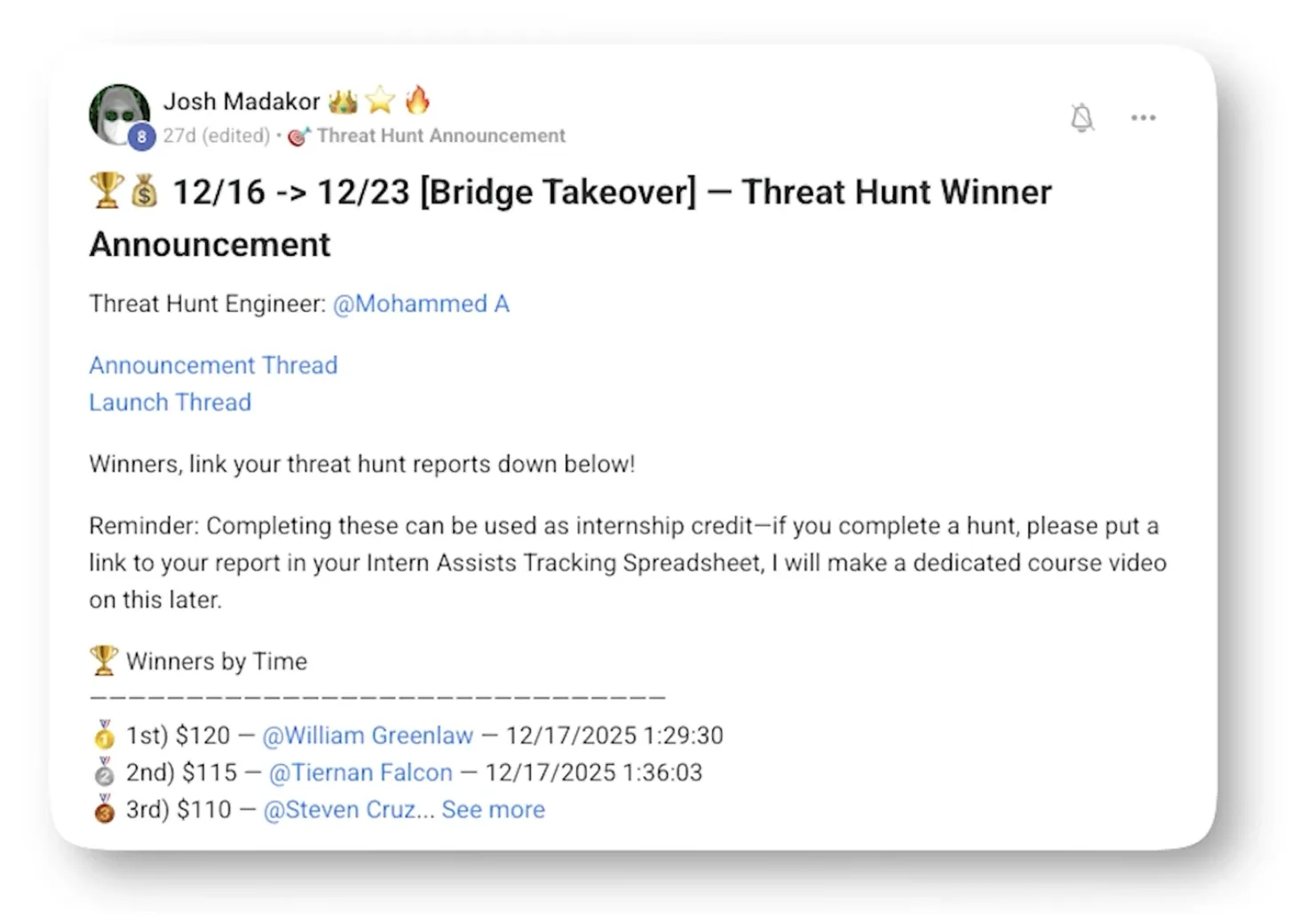
- Complete one community threat hunt — a bi-weekly, story-driven capture-the-flag exercise where you follow breadcrumbs through real logs to find flags and submit a report
- Request your Cyber Range internship certificate of completion, then list LogN Pacific on your resume
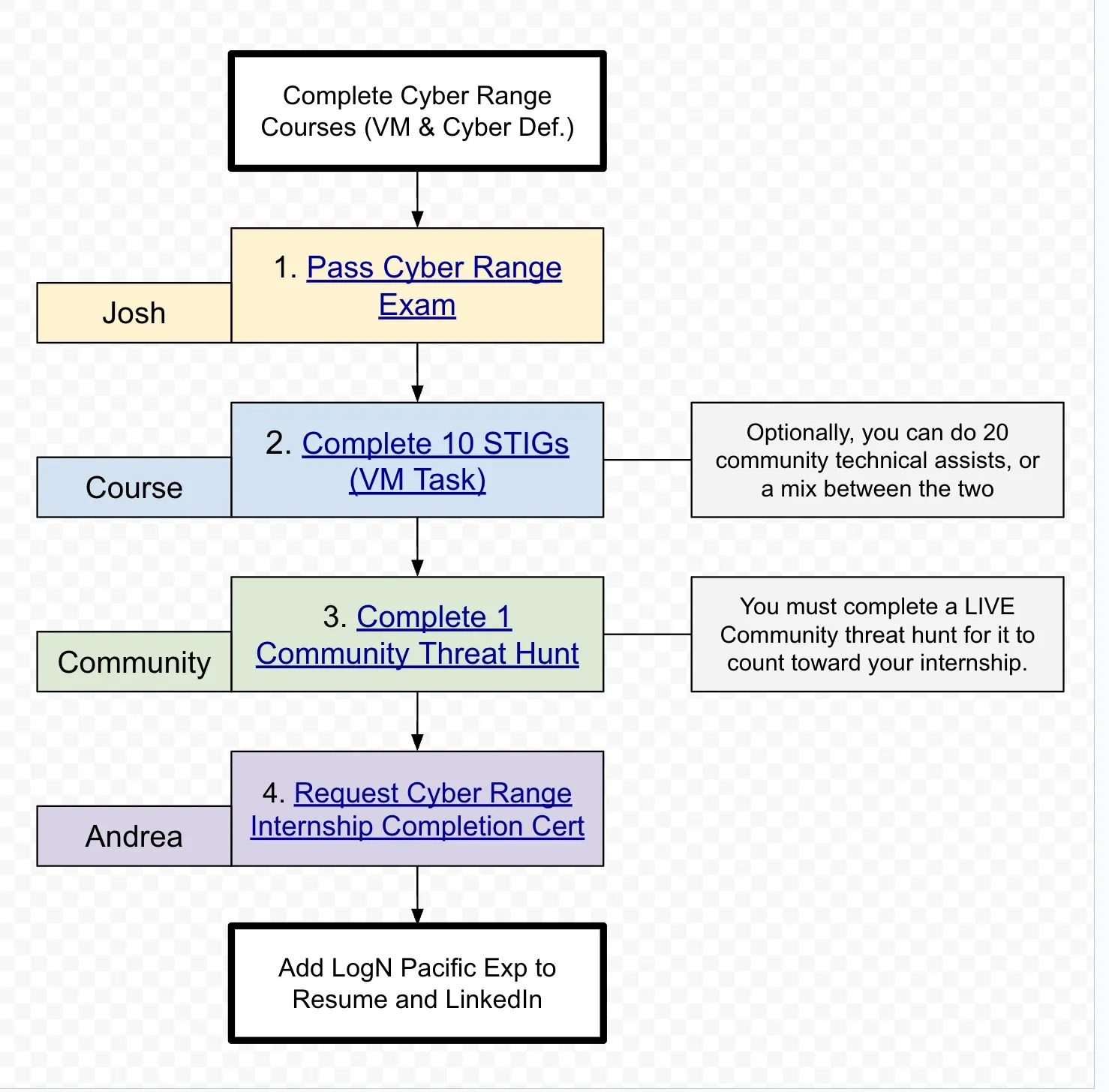
For the vulnerability management task specifically: you stand up a VM, scan it against STIG compliance (the same security technical implementation guidelines the U.S. military uses), find the missing controls, remediate them, then re-scan to confirm the fixes actually stuck.
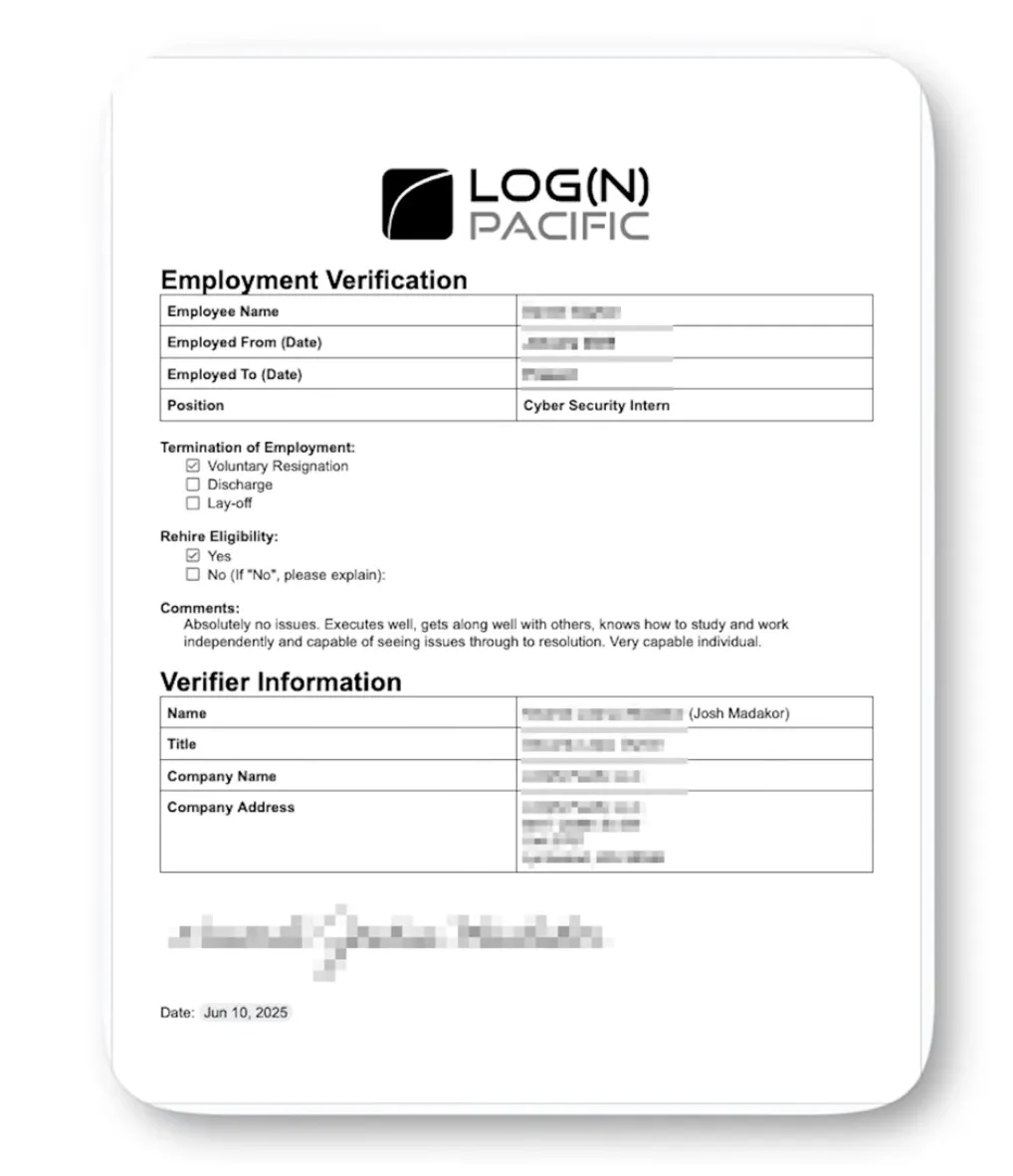
Once you’re hired or a company gets interested, they can reach out to us directly, and we provide a standardized employment reference confirming your experience.
Now, the honest paid/unpaid breakdown. The standard internship pipeline above is unpaid. Beyond that, there are a couple of cases where money does change hands:
- Winners of each bi-weekly threat hunt split a cash prize pool (currently 1st place $120, 2nd $115, 3rd $110, plus seven randomly-selected bonus winners from everyone who completed it)
- Every once in a while, I’ve paid someone directly for things like incident analysis when something actually happened in the environment, or a large piece of content — that’s more the exception than a standing offer
One member, Steven Cruz, has completed 9 of these threat hunts, taken first place in 5 of them, and has genuinely won more in prize money than his monthly subscription costs — so on paper, I’ve lost money on him. That’s not the norm, but it’s a real example of how the paid side works for people who get good at it.
A note on the older internship article on this site: if you’ve read my Cyber Security Internship Program breakdown, that piece describes a much earlier, simpler version of this program — before the exam requirement, the threat hunt requirement, or The Cyber Range branding even existed. This article reflects the current, revamped version.
Real Wins From Inside The Range
I’m not going to cherry-pick polished marketing testimonials for this. Here are three recent posts pulled straight from the community’s “Wins” channel — read them for yourself.
What You Actually Get When You Join
Here’s the practical walkthrough of what happens after you sign up:
- You get access to the private community and introduce yourself
- You get access to the live Cyber Range environment and all the enterprise tools
- You work through community courses covering security operations, vulnerability management, threat hunting, and resume/portfolio building
- You follow a provided roadmap of specific things to accomplish, each rated F-tier through S-tier (one example: listening to 100 episodes each of Darknet Diaries and The Cyber Ranger Daily to build your industry vocabulary — that’s an S-tier version of that particular roadmap item)
- You get access to the optional internship
- There’s a weekly live Q&A where you can ask me anything directly
The Honest Cons
Since this is supposed to be a real review and not a sales page, here’s what I’d tell you if you were a friend asking whether to join:
- It’s genuinely expensive. At $129/month, it’s one of the pricier communities on Skool. It’s still cheaper than a $15K bootcamp, but it’s not a casual impulse buy.
- The internship takes real time. If you’re expecting to skim through and land a job in two weeks, that’s not how this works.
- You’re sharing a live environment with roughly 1,500 other members. It’s not a private sandbox just for you.
Is a Job Guaranteed?
No. If anyone guarantees you a job for buying a course or joining a community, that person is scamming you — unless they’re the one planning to hire you directly.
What I can actually guarantee is this: if you go through the roadmap at an S-tier level of effort, you’ll end up significantly more employable than when you started, with real experience you can talk about in an interview. Best case, you land close to your dream role. Realistic case, you land some entry-level IT or cybersecurity job that might not be exactly what you pictured, but it’s a foot in the door you can leverage from there. Worst case — and this happens more than you’d think — you join and just don’t do the work, in which case nothing happens. That last outcome has nothing to do with the community and everything to do with execution.
If any of what’s described above — the live SOC, the tools, the internship — sounds like what you’ve been missing, you can check out The Cyber Range directly and see the current price and trial details for yourself. And if you’re not ready to commit to a paid community yet, my free Cyber Community is a solid place to start.
Frequently Asked Questions
Is the internship paid?
The standard pipeline (courses, exam, vulnerability management task or community assists, one threat hunt) is unpaid — it’s structured as verifiable work experience rather than a formal paid role. That said, people who build or win the bi-weekly threat hunts do get paid, and I occasionally pay members directly for content work or incident analysis. So “paid” isn’t a flat no, it’s “not through the default path.”
How fast are people actually getting hired?
In 2026, someone from the community lands a job roughly every 3 days on average. About half of those are general IT roles rather than cybersecurity-specific titles, so the internship’s value isn’t limited to landing a “cybersecurity analyst” job title specifically.
Do I need a degree or IT experience before joining?
No. The whole point of the tier list is that a degree is B-tier — helpful, but not required if you build up S-tier and A-tier things like real experience and high-end projects instead.
Is a job guaranteed if I join?
No, and you should be skeptical of anyone who tells you otherwise. What’s realistic is a significant increase in how employable you are if you actually put in the work.
How is this different from free tutorials on your YouTube channel?
My free labs (like the home SOC / honeypot project) are intentionally simplified versions of what’s inside The Cyber Range. The paid community gives you the full-depth version with enterprise tools, a shared live environment, courses, and the internship on top.
Do I need a powerful computer or VM software to do the labs?
No. Everything runs in a browser, including remote desktop access, which goes through Azure Bastion rather than requiring local virtualization software. If your laptop can’t handle running VirtualBox, that’s not a blocker here — though if you’re shopping for a new machine anyway, I’ve got a laptop recommendation guide that covers what actually matters for this kind of work.
How is this different from the older course sold under the Leveld brand?
The older version had each student working in their own isolated Azure environment. The Cyber Range puts everyone in the same shared network with access to the same company-licensed Tenable and Defender for Endpoint subscriptions — it’s closer to actually working alongside coworkers than completing an isolated course.
What kinds of tasks can I actually do for internship credit?
A few different types: STIG-based vulnerability remediation using PowerShell (submitted through GitHub), building and running bi-weekly threat hunt scenarios, general community technical support, and custom tasks tailored to what you specifically want experience in — for example, someone wanting IAM experience was given subscription-reader access to run an actual IAM audit.
How much can I realistically expect to make starting out?
It depends heavily on location. Entry-level tends to land around $50K in lower cost-of-living areas, and somewhere in the $65K–$85K range in most metro areas.